
Hi, if you’re here, you’re probably doing what I did at 2am while pregnant. Googling baby bottles, reading ingredient claims, and suddenly questioning everything in your kitchen.
I went way too deep on Hegen so you don’t have to.
I looked at the company, the patents, the bottle materials, the safety claims, the real parent feedback, the low-tox questions, and how Hegen stacks up against the other bottles parents usually end up comparing when they’re trying to buy fewer, better things.
And there’s one thing I need to say right away because it changes the entire conversation.
Hegen is very often talked about online like it’s a glass baby bottle. But the brand’s own product pages describe its feeding bottles as PPSU, not glass.
That does not automatically make Hegen bad. It just means a lot of parents are landing on Hegen while searching for glass bottles, and what they’re actually finding is a premium PPSU bottle system that gets marketed as having some of the best practical parts of glass without the breakage.
So this post is not going to hype it up or tear it down. I’m just going to tell you what it actually is, what I found, what looks solid, what still feels a little fuzzy, and whether I’d recommend it to a friend who really does care about materials but also has to wash bottles half asleep.
My Bottom Line Before We Get Into Everything
- Hegen’s official bottle material is PPSU, not glass.
- Hegen was launched in Singapore in 2015 by founder Yvon Bock, and the brand is closely tied to Fitson, the manufacturing company behind it.
- The signature feature is the patented Press-to-Close, Twist-to-Open closure, which is genuinely one of the main reasons parents love it.
- The biggest real-life pros are easy cleaning, fewer parts, one-handed use, modular storage, and less clutter.
- The biggest real-life complaints are price, occasional leaks or spills, and the fact that not everyone loves the square shape or closure system in practice.
- Hegen makes strong safety claims around PPSU, but I still could not find a public, bottle-specific Hegen lab report that fully settles the low-tox conversation for the most cautious parent.
- If you want true glass, I would not buy Hegen thinking that’s what you’re getting.
- If you want a premium, lighter, more convenient bottle system that feels more thoughtful than a basic plastic bottle, I can absolutely see why people get hooked on Hegen.

The First Thing That Surprised Me
I started this research expecting to write about Hegen as a glass bottle brand.
That’s because if you spend enough time in bottle threads, registry lists, mom groups, and product roundups, Hegen often gets talked about in the same breath as glass bottles, or as this super safe premium bottle option that people mentally file into the same category.
But when you go back to the actual product pages, Hegen’s feeding bottles are listed as PPSU. The official Hegen product pages say “All Hegen bottles are made of PPSU (Polyphenylsulfone)” and describe it as a material that combines the advantages of both glass and plastic. You can see that directly on Hegen’s 2 oz, 5 oz, 8 oz, and 11 oz bottle pages and on the brand’s PPSU materials pages: 2 oz bottle, 5 oz bottle, 8 oz bottle, 11 oz bottle, Hegen PPSU page, and Hegen USA PPSU page.
So if you are here specifically because you want a true glass bottle, that is the first thing I would want a friend to know before she spends premium-bottle money.
That said, I also get why people group Hegen into the low-tox conversation. PPSU is not just generic bargain plastic. It’s a higher-end plastic material that brands position as durable, heat-resistant, and more stable under repeated sterilizing than the cheaper stuff. In the Hegen world, that is basically the whole pitch.
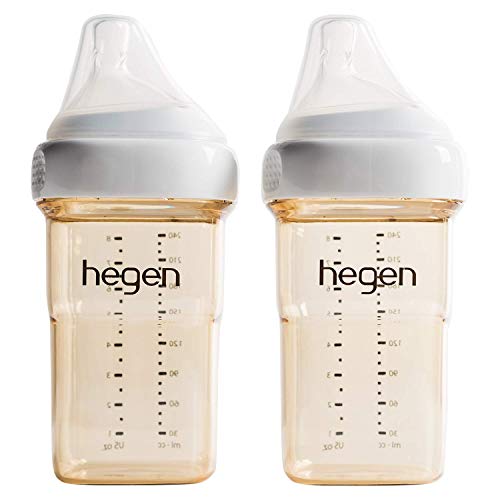
One-handed PCTO baby bottle: anti-colic, breast-like teat, hot-liquid safety vent, stackable PPSU design that grows into storage. Tap to learn more.
Price and availability are accurate as of 10/15/2026 09:11 pm GMT and are subject to change.
Hegen is not really a glass bottle story. It’s a premium PPSU bottle story that gets pulled into glass-bottle conversations because parents are trying to avoid the flimsy, disposable feeling of standard plastic bottles.
So What Is Hegen, Exactly?
Hegen is a Singapore brand launched in 2015 by founder and CEO Yvon Bock. The company story matters here because Hegen does not feel like one of those random baby brands that started with a trendy logo and worked backwards. It feels like a brand built around a very specific feeding workflow.
According to Hegen’s own brand pages, the idea was to modernize the whole express, store, and feed process so parents could move milk through fewer containers with less hassle. That still shows up all over the product line today. You see it on the official Hegen brand story pages and in the company’s press materials: Hegen brand story, 10-year anniversary release.
There’s also a manufacturing angle that is unusually visible. Hegen is closely tied to Fitson, a Singapore company that says it has been manufacturing mother-and-baby products since 1984 and created its own brand, Hegen, in 2015. Fitson publicly lists operations in Singapore and Johor, Malaysia, and it also lists ISO certifications including ISO 9001, ISO 13485, ISO 14001, and ISO 45001.
I actually think that matters. It does not prove every bottle is perfect. But it does make Hegen feel more like a serious product system than a trendy brand with nice packaging and weak infrastructure behind it.

10/15/2026 09:11 pm GMT
The Part of Hegen That Is Actually Different
The biggest thing Hegen has going for it is not the material debate. It’s the closure system.
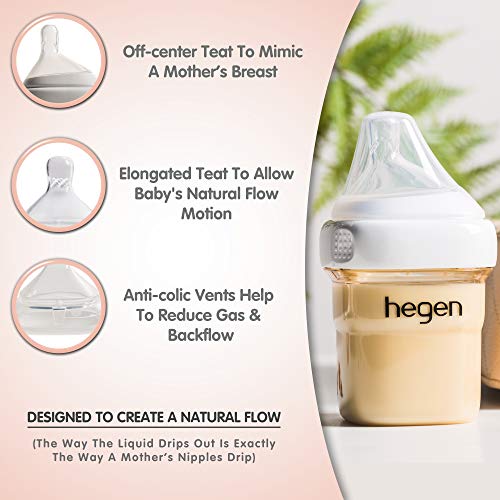
Hegen’s whole identity is built around its patented Press-to-Close, Twist-to-Open design, usually shortened to PCTO. If you’ve ever been annoyed by lining up bottle threads while holding a hungry baby, this is the part that makes people weirdly loyal to the brand.
The patents are real, not just marketing copy. Google Patents shows a Fitson-held patent for the closure and feeding bottle system and a separate bottle design patent: US10159628B2 and USD766451S1.
The bottle is also built around that square-rounded “Sqround” shape. That sounds gimmicky until you think about bottles rolling off counters, bottles taking up weird space in the fridge, and how annoying some round bottle systems are once you have a bunch of them.
- Press-to-Close, Twist-to-Open instead of a typical screw-thread setup
- Wide opening for easier cleaning
- Off-center teat meant to support a more upright feeding angle
- Modular system that lets you swap tops and reuse the same containers for storage and later stages
- Stackable storage style that appeals to pumping moms and anyone who hates clutter
On paper, Hegen is basically trying to be the bottle version of a really good kitchen system. Less transferring, less fiddling, fewer annoying parts, less chaos.

What Hegen Sells Right Now
As of the current official product pages, Hegen’s feeding bottles are sold in these sizes:
- 60 ml / 2 oz with extra slow flow teat
- 150 ml / 5 oz with slow flow teat
- 240 ml / 8 oz with medium flow teat
- 330 ml / 11 oz with fast flow teat
You can verify those on Hegen’s official bottle pages: 2 oz, 5 oz, 8 oz, and 11 oz.
What I like about the system is that Hegen does not really think of these as just bottles. The same containers can also become breast milk storage containers, drinking bottles, straw cups, or other feeding-stage products depending on the lid or top. That is straight from the product ecosystem itself, and it’s one of the stronger arguments for the brand if you like reusable systems: 5 oz storage, 8 oz storage, 11 oz drinking bottle.
This is honestly where Hegen starts to make more sense. It is expensive if you think of it as just a bottle. It feels more rational if you think of it as a full feeding and storage system.
What Real Parents Actually Say
This was one of the most useful parts of the research because it moves the conversation out of brand language and into actual daily life.
I wanted real comments from actual parents in public threads, not fake polished testimonials, so I pulled from public Reddit results where the snippets were visible and easy to verify.
The praise is pretty consistent
“Hegen! I feel like it’s more versatile… you get every last drop!”
Reddit parent comment
“The click lids seal great and are so much easier than twist tops…”
Reddit parent comment
“They’re so easy to clean… it’s the only bottle my baby takes seriously.”
Reddit parent comment
“With Hegen, there has been no/very minimal leak.”
Reddit parent comment
Those comments line up with the broader pattern I kept seeing. Parents tend to like Hegen for convenience, easy cleaning, fewer parts, modular storage, and the closure system. The people who love it really do sound attached to the workflow, not just the look.

But the annoying complaints are real too
“This happens to us too. Really frustrating…”
Reddit parent comment about spills after drops
“The square shape [was] a little awkward to hold…”
Reddit parent comment
“The nipples can be tricky to get on right.”
Reddit parent comment
This part matters because every premium baby product starts sounding flawless once enough affiliate posts get written about it. But real parents usually tell you the thing you actually need to know.
In Hegen’s case, that seems to be this:
- Many parents really do find it easier to clean than brands with more vent pieces
- Many parents genuinely love the closure system
- Some parents still deal with spills or leaks, especially around setup or when the bottle gets dropped
- Some babies do great with the teat and nipple shape, while others don’t
- The square shape looks nice but is not universally loved in the hand
- The price makes every small annoyance feel bigger
That feels honest to me.
What Hegen Claims About Safety
Hegen makes the kind of claims you would expect from a premium bottle brand, and some of them are stronger than the vague copy you see from cheaper brands.
On the official Hegen PPSU materials pages, the brand says its PPSU range is made from FDA compliant food-contact grade material and is free of BPA, BPS, Phthalates, and PVC. The pages also say the material is naturally amber-colored and contains no added pigments: Hegen PPSU page.
The current U.S. Hegen PPSU page also uses “medical-grade” language and positions PPSU as a hospital-trusted material: Hegen USA PPSU page.
And Hegen’s product-support pages say PPSU can stand up to the heavy sterilizing and repeated use that happen during the first months of baby life better than standard plastics: Hegen support on PPSU bottle use.
That all sounds good. But this is also where I think parents can get lulled into feeling like the safety conversation is fully settled when it isn’t.
Brand claims are useful. They are not the same thing as a public product-specific migration report.
What I Found on Toxicity, Heavy Metals, and the Low-Tox Question
If you’re reading this from a practical low-tox mindset, you probably are not just asking “Is it BPA-free?” You’re asking a bigger question.
You’re asking whether this is the kind of product you can feel good about heating, washing constantly, sterilizing, and using multiple times a day for months.
What feels solid
- Hegen is upfront that the bottles are PPSU, not mysterious “premium material” wording
- The official materials page clearly says BPA-free, BPS-free, phthalate-free, and PVC-free
- Fitson publicly lists manufacturing certifications and a serious manufacturing footprint
- The whole system looks much more engineered than a cheap bottle off a marketplace seller
What still feels incomplete
- I did not find a public Hegen bottle report that fully lays out migration testing under realistic feeding and sterilizing conditions
- I did not find a public Hegen-specific heavy metals report covering each bottle component
- I did not find a Mama Natural style dedicated Hegen toxicity review that I would call definitive
This is where broader bottle safety reporting helps provide context. Consumer Reports’ 2025 baby bottle testing didn’t detect BPA, lead, or phthalates in the bottles it tested, but it also made the point that other concerns can remain, especially with heating and with chemicals that were not part of that specific testing panel.
And on the glass side, Lead Safe Mama’s baby bottle guide is one reason parents got more serious about bottle markings and coatings in the first place. That guide is heavily focused on lead in painted or decorated glass bottles, and it makes the separate point that modern plastic bottles generally are not where lead positives show up.
So this gets a little more nuanced than “glass good, plastic bad.”
- Glass avoids some of the plastic migration worries, but can raise questions about exterior paint and markings depending on the brand
- PPSU avoids the breakage problem and some of the low-grade plastic complaints, but it is still a plastic material, which is exactly why some parents keep pushing for more transparency than brand copy alone
My honest take is this. If you are the kind of parent who wants the cleanest, simplest material story possible, true glass is still easier to emotionally feel good about. But if you are a practical parent who wants something that feels far more durable and polished than regular plastic without the stress of glass, Hegen is exactly the kind of bottle that is going to tempt you.
Did Mama Natural or Other Big Safety Influencers Specifically Test Hegen?
I looked for this because I know that’s how a lot of moms search. Not just “what does the brand say,” but “did anyone I already trust go deep on this?”
I did not find a dedicated Mama Natural Hegen toxicity report that I would feel comfortable citing as the answer. That does not mean it doesn’t exist somewhere in a video or story format. It just means I could not verify one in a clean, article-level way that I’d want to repeat as fact.
What I did find was more of a scattered pattern:
- Mainstream parenting outlets highlighting the convenience and design
- General bottle-material discussions in low-tox spaces
- Independent heavy metals and lead reporting focused more on glass bottle coatings than on Hegen specifically
- Parent reviews focusing much more on cleaning, leaks, and baby acceptance than on lab chemistry
So if you were hoping there was one famous low-tox mom review that already did all the chemistry homework on Hegen for you, I could not honestly tell you that I found that.
How Hegen Compares to Other Bottles Parents Usually End Up Comparing
If you are shopping Hegen, you are probably not comparing it to the cheapest standard bottle on the shelf. You are usually comparing it to other bottles that feel more intentional, more premium, or more low-tox.
| Brand | Main Material | What It Does Best | What I’d Watch Out For |
|---|---|---|---|
| Hegen | PPSU | Excellent system design, easy cleaning, one-handed closure, modular storage, premium feel | Not true glass, pricey, still plastic, mixed spill/leak complaints, no public product-specific lab report that settles everything |
| Philips Avent Glass | Glass | Simpler material story, fewer parts, easy to find, official borosilicate glass pages | Still glass, heavier, more basic system feel |
| Dr. Brown’s Glass | Glass | Best known for colic-focused venting, easier sell for very gassy babies | Way more parts, more washing, more setup fatigue |
| Lifefactory | Borosilicate glass with silicone sleeve | Strong low-tox appeal, glass plus sleeve, very straightforward material story | Still glass, bulkier, not as elegant a storage system |
| Pigeon Glass | Glass | Popular with parents focused on breast-to-bottle transition | Can be harder to find depending on where you shop |
Here are the official pages I’d use as a starting point if you want to compare the material story for yourself:
This is the simplest way I can put it:
- If you want true glass, Hegen is probably not your answer.
- If you want a bottle system that feels beautifully thought through in actual daily use, Hegen makes a very strong case.
- If you want the most convenient middle ground between fragile glass and generic plastic, this is exactly the lane Hegen is trying to own.


Price and availability are accurate as of 04/15/2026 04:34 am GMT and are subject to change.
What Hegen Costs, and Why That Matters
Hegen is not cheap, and I actually think the price shapes how people feel about every other part of the experience.
Current official Hegen bottle pages show pricing in the low-to-mid $30 range per bottle on the main Hegen site for the standard sizes at the time of writing. You can check the current listings directly here: 5 oz, 8 oz, 11 oz.
That means you are not just buying “a bottle to see if this works.” You are buying into a premium system.
And whenever a bottle gets expensive, the standards go up fast. Parents stop being forgiving about little spills, awkward parts, or a nipple their baby only kind of likes. That’s why you see praise and criticism both sounding stronger with Hegen than they do with more ordinary bottles.
Premium baby products do not just have to work. They have to feel worth it at 2am.
Who I Think Hegen Makes Sense For
- The parent who is pumping and storing milk enough to really care about system design
- The mom who hates bottle clutter and wants one set of containers doing multiple jobs
- The parent who wants something more durable and nicer than standard plastic but does not want to deal with glass breakage
- The family willing to pay more for convenience, simplicity, and nicer day-to-day use
- The parent who values fewer parts and easier cleaning over a fully glass setup
Who I Think Should Probably Skip It
- The parent who specifically wants true glass and does not want to debate plastics anymore
- The family on a tighter budget who would rather buy simpler bottles and spend the difference elsewhere
- The parent who hates learning curves in baby products
- The mom who wants a very public, very transparent, low-tox testing trail before she buys
- Anyone whose baby already has a bottle they love and who does not want to mess with nipple preferences
If I Were Recommending Hegen to a Friend
I would say this:
If you are interested in Hegen because you want a premium, easier, more polished feeding system, I get it.
If you are interested in Hegen because you thought it was a true glass bottle, I would pause.
I would also tell her not to buy a huge set right away.
Not because Hegen is bad. Just because bottles are one of those product categories where the internet acts like there is one universally best option, and that is just not how real babies work.
Some babies love certain nipples. Some babies hate them. Some parents will gladly trade a little awkwardness for fewer wash parts. Other parents would rather deal with a different bottle than have one more premium thing in the kitchen that needs to be handled exactly right.
So if I were doing this in real life, I would buy:
- One or two Hegen bottles if the system really appeals to you
- One true glass option from a brand like Avent Glass or Lifefactory if material simplicity matters a lot to you
- Test them for a week
- Pay attention to leaks, washing, how your baby takes the nipple, and which one you actually reach for when you are tired
Because the best bottle is still the one your baby takes and the one you don’t dread cleaning.
One-handed PCTO baby bottle: anti-colic, breast-like teat, hot-liquid safety vent, stackable PPSU design that grows into storage. Tap to learn more.
Price and availability are accurate as of 10/15/2026 09:11 pm GMT and are subject to change.
My Final Take
After digging through all of this, I do think Hegen earns some of its reputation.
The brand story is real. The design work is real. The patents are real. The system thinking is real. And the parent praise around convenience and cleaning does not feel made up to me. It feels like the kind of praise products get when they genuinely make daily life easier.
But I also think the online conversation around Hegen can get a little fuzzy, especially when it starts getting bundled into “glass bottle” discussions without enough clarity.
Hegen is not the bottle I would buy if my top goal was true glass.
Hegen is the bottle I would consider if my top goal was a premium, easier, less annoying feeding system that still feels a lot better than regular plastic.
That’s the most honest way I know to say it.
It’s not really a “glass bottle winner.” It’s more like a beautifully engineered PPSU bottle system that makes a strong case for itself if convenience matters almost as much as materials do.
Sources I’d Actually Click If I Were Double-Checking This Myself
- Hegen 2 oz bottle page
- Hegen 5 oz bottle page
- Hegen 8 oz bottle page
- Hegen 11 oz bottle page
- Hegen PPSU materials page
- Hegen USA PPSU page
- Hegen 10-year anniversary release
- Hegen company background release
- Fitson about page
- Closure and feeding bottle patent
- Bottle design patent
- Consumer Reports baby bottle testing
- Lead Safe Mama baby bottle guide
- Philips Avent glass bottle page
- Lifefactory 4 oz glass bottle
- Lifefactory 9 oz glass bottle
Note: This article is based on publicly available brand pages, patents, public retailer and media context, and public parent discussions. It’s not medical advice, and it’s not a substitute for product-specific lab testing if you want the strongest possible safety proof.

Leave a Comment